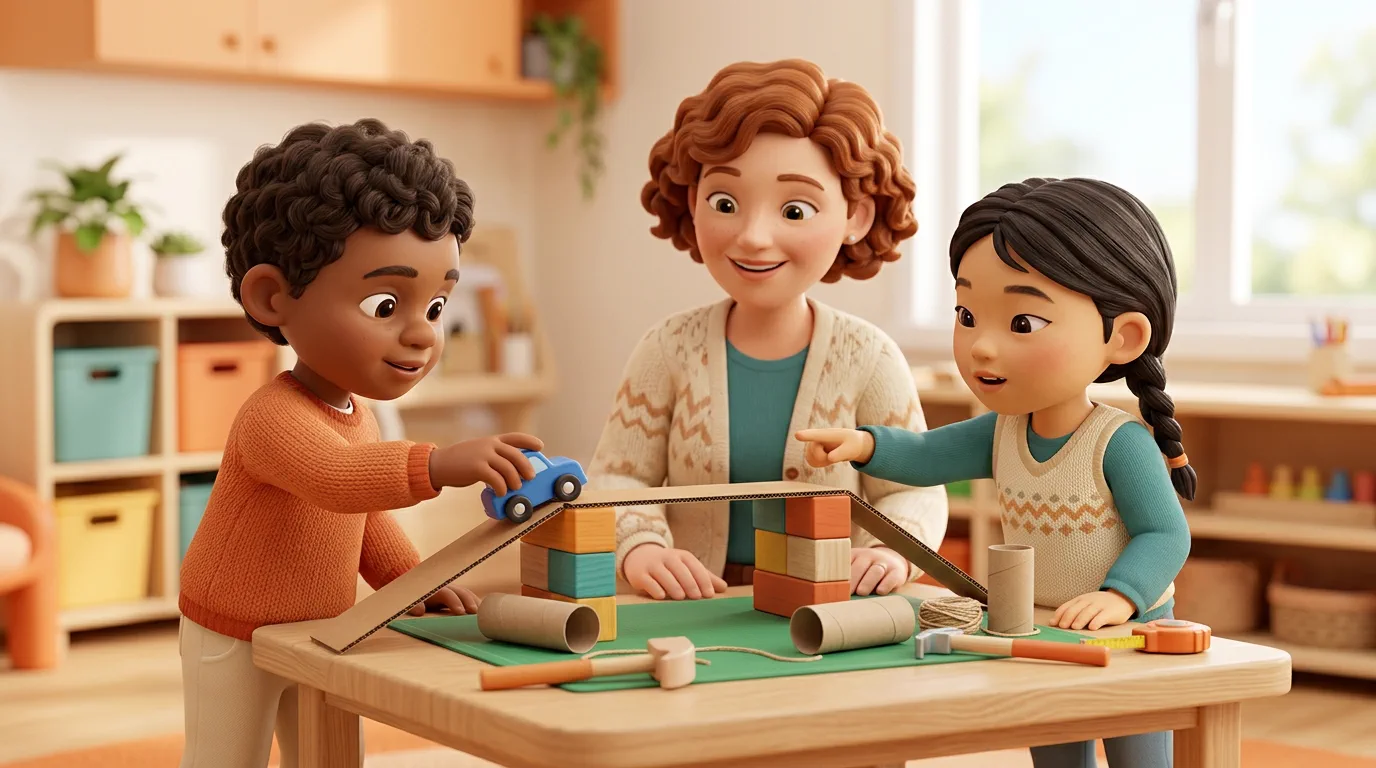
These problem solving activities preschool children can try use blocks, cardboard and familiar household materials to turn a small challenge into purposeful play. The aim is not to produce a perfect model. It is to give children room to notice a problem, suggest an idea, test it and decide what to change.
Australian early-learning guidance describes play-based learning as a setting where children can make decisions, test ideas, solve problems and build new understanding. Adults can support that process by asking questions and offering just enough help to keep the child thinking. The seven activities below use that approach while introducing simple ideas from the built world: strong bases, clear routes, bridges, shelters and teamwork.
Why play is a useful setting for problem solving
Preschool children often explore a problem with their hands before they can explain it in words. A tower leans, a cardboard road has a gap or a toy shelter is too small. Each result gives the child something visible to think about.
Keep the challenge open enough for more than one answer. Instead of showing the finished solution, begin with a question such as “How could we make this stand up?” or “What could the toy use to cross the gap?” Follow the child’s interest, allow time for another attempt and treat a change of plan as part of the activity.
Before you start: simple materials and safe boundaries
Choose clean, age-appropriate materials that are easy for the child to move. Useful options include large blocks, plastic cups, cardboard strips, paper, masking tape, fabric and toy figures. An adult should stay nearby, especially when scissors, tape, small parts or recycled materials are used. Avoid sharp edges and remove objects that could be a choking hazard for the children taking part.
Set one clear boundary before play begins: these are make-believe building challenges for home, preschool or a classroom. Children should never enter a construction site or touch real tools or equipment. Real worksites are for trained and authorised teams.
Three building challenges to test and improve
- **1. Cup tower with a strong base:** Invite the child to build a tower from cups or large blocks. If it tips, ask what they notice about the bottom layer. Let them compare a narrow base with a wider one and choose which design to test again.
- **2. Cardboard bridge for a toy:** Place two books or blocks a short distance apart and provide cardboard strips for a bridge. Ask the child to help a toy car or figure cross the gap. They can change the span, add supports or use another layer of cardboard. Use light toys only and keep fingers clear when the bridge is being tested.
- **3. Shelter for a toy animal:** Offer blocks, cardboard and a small piece of fabric. The challenge is to make a shelter that fits the toy and stays standing. Ask what a roof needs, where an entrance could go and what might make the walls steadier.
These activities connect naturally with the way children see buildings in their neighbourhood. They do not need technical vocabulary. Words such as base, support, roof, wide, narrow, over and under are enough to help adults and children talk about what they can see.
Two route and sorting challenges
- **4. Build a road around an obstacle:** Mark a start and finish point on the floor with paper or removable tape. Add a cushion, box or block as an obstacle. The child can arrange cardboard “roads” so a toy vehicle reaches the destination without crossing the obstacle. Change the obstacle after the first successful route.
- **5. Sort the builder’s materials:** Use a small collection of large, safe objects in different shapes, colours or textures. Ask the child to sort them once, explain the rule and then invent a different rule. For example, pieces might first be grouped by colour and then by whether they can stack or roll.
The purpose is not to find one correct rule. It is to notice properties, explain a choice and discover that the same materials can be organised in more than one useful way.
Two teamwork challenges
- **6. Move the supplies together:** Put several soft blocks or cups at one end of a table and a “building zone” at the other. Two children work together to move the supplies using a tray, piece of cardboard or container. They can decide who carries, who steadies and how many items are safe to move at once.
- **7. Create a small neighbourhood:** Give children paper, boxes and blocks to make a few simple places such as a home, park, school or bridge. Then ask how people and toy vehicles will move between them. Children can add paths, change the layout and explain why they put each place where it is.
If children disagree, pause the building rather than choosing a winner. Ask what each person wants the shared design to do and whether they can test both ideas. The conversation is part of the challenge.
How adults can help without taking over
Useful prompts keep attention on the child’s observation and next decision:
- “What have you tried so far?”
- “What do you notice now?”
- “Which part could you change?”
- “Can you think of another way?”
- “What do you predict will happen?”
Offer a small clue only when it is needed. You might point to a leaning base, provide a larger piece of cardboard or reduce the number of materials. Avoid turning the activity into a test or comparing one child’s model with another. If interest fades, stop and return another day.
Notice the process rather than judging the finished object. A child might try a second idea, explain why a part moved, ask someone for help or decide to simplify the design. Those observations can guide the next conversation, but the activity is not a developmental assessment and does not guarantee a particular learning outcome.
Connecting the activities with Brave Buddy
Brave Buddy Australia turns the built environment into stories children can understand. These small building and teamwork challenges give families and early-years educators a practical way to continue that curiosity away from the screen while keeping the construction setting imaginary and age-appropriate.
Educators can explore Brave Buddy’s education approach, families can meet the characters through The Show, and classrooms wanting a more structured follow-on can use the free bridge-building challenge. Each next step keeps the focus on asking questions, testing ideas and understanding the world we build.
Good problem solving activities preschool children return to are simple, flexible and open to more than one solution. Start with one challenge, stay close enough to keep the materials safe, and let the child’s next idea shape what happens.