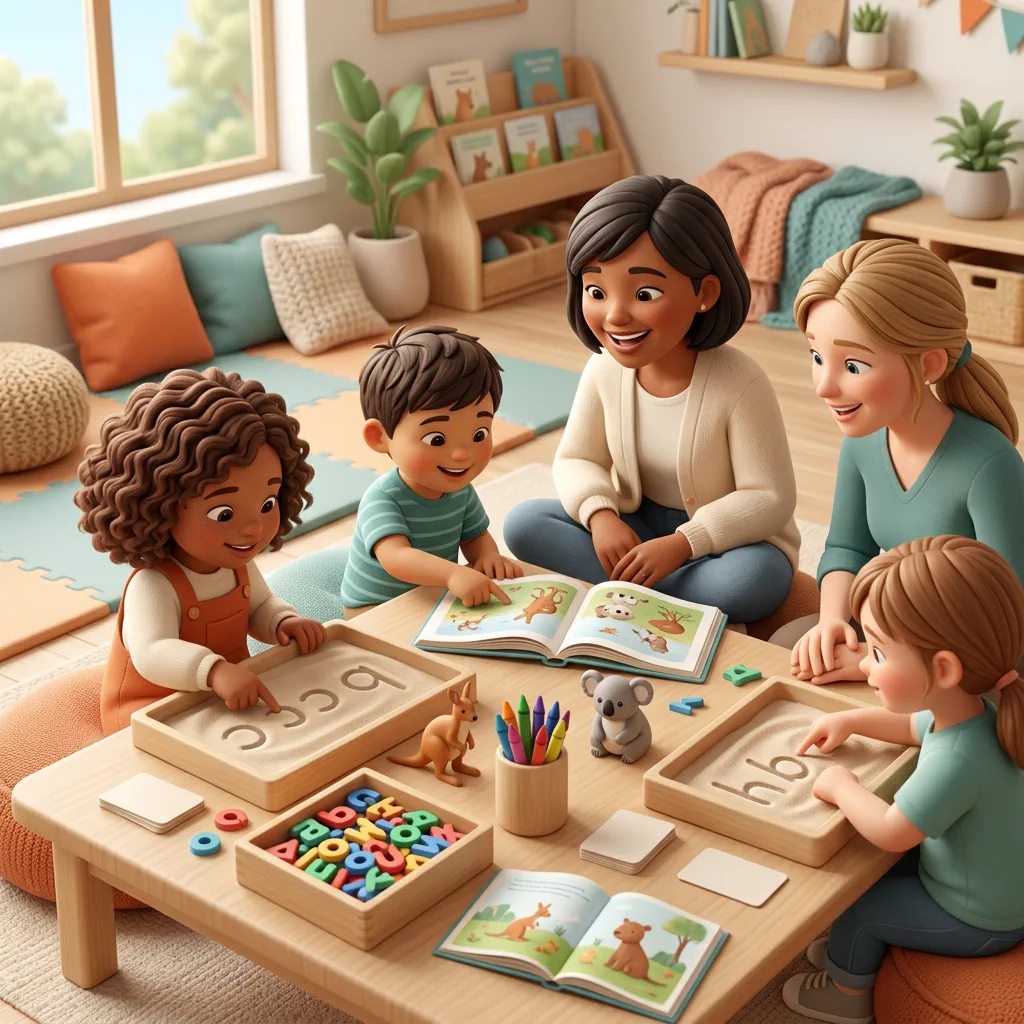
Literacy activities for preschoolers work best when they feel like play. At this age, children learn through talking, singing, sorting, drawing, pretending and noticing print in everyday life. The goal is not to rush them into formal reading or writing, but to give them many small, enjoyable chances to listen for sounds, tell stories, notice letters, and experiment with marks on paper.
If you are a parent or early-years educator, the most useful activities are the ones you can set up quickly, use with mixed ages, and repeat without needing special materials. The ideas below are screen-light, low-prep and flexible. They can be used at home, in a classroom corner, or outdoors, and you can make them easier or more challenging depending on each child’s interests and stage.
What literacy looks like in the preschool years
For preschoolers, literacy is broader than reading words on a page. It includes speaking clearly, listening to others, understanding stories, recognising familiar signs, noticing letters in names, and making meaning from pictures.
Children also need plenty of practice with fine-motor control, attention and memory. That is why activities that involve painting, building, sorting, moving and role-play can support literacy just as much as books do.
A good rule of thumb is to keep the activity playful, short and repeatable. If a child wants to do the same game again and again, that repetition is doing useful work.
Story talk that builds vocabulary
One of the easiest literacy activities for preschoolers is simple story talk. Choose a picture book, a set of toy animals, a family photo, or even a walk outside, and ask open questions.
Try prompts like:
- What do you notice?
- What might happen next?
- How do you think that character feels?
- Can you tell me the story in your own words?
If a child gives a short answer, you can gently extend it. For example, if they say, “Dog,” you might reply, “Yes, a dog is running fast through the grass.” This models richer language without turning the moment into a test.
A useful variation is “picture talk.” Look at an illustration together and take turns naming objects, actions and feelings. This helps children practise vocabulary, sequencing and observation.
Sound games for listening and awareness
Before children read, they need to hear how words work. Sound play builds that awareness in a natural way.
You could try a simple sound hunt. Say, “Let’s find things that start with mmmm,” then look for a mat, mug or monkey toy. Keep the focus on the first sound rather than the letter name if that feels easier.
Another option is a rhyming basket. Gather a few objects or picture cards and group items that sound alike at the end, such as cat, hat and bat. If true rhymes are too tricky, children can still enjoy making silly sound pairs and hearing the rhythm of words.
Clapping syllables is another favourite. Say a child’s name, a favourite animal or a snack, and clap the beats together. For example, “par-a-keet” or “ban-a-na.” This supports listening and word awareness without requiring any print.
Hands-on activities for letters and marks
Preschoolers do not need to sit at a desk to begin exploring writing. In fact, many children engage more easily when letters and marks are part of movement and play.
Try letter tracing in unusual materials such as sand, shaving foam, finger paint or a tray of rice. Children can use a finger, a stick or a paintbrush to make broad, confident shapes. The sensory feedback helps them notice how letters are formed.
You can also set up name play. Write the child’s name on a card, then ask them to match magnetic letters, stamps or sticky notes to the letters they can see. For older preschoolers, invite them to find the first letter of their name in magazines, street signs or labels.
If a child is not ready for letter recognition, keep the focus on marks and meaning. Provide paper, crayons, envelopes, clipboards or sticky notes and invite them to make lists, menus, signs or messages in pretend play.
Pretend play that invites reading and writing
Pretend play is a rich way to build literacy because it gives children a reason to speak, listen, negotiate and use print.
Set up a shop, café, post office, vet clinic or repair station. Add menus, labels, receipts, badges, appointment cards or simple signs. Children can take orders, write lists, draw maps, or leave messages for each other.
A construction-themed play area can also support literacy naturally. Children might make a plan for a tower, label different parts with drawings, or use a clipboard to “check” what needs to be built next. The purpose is not to turn play into a lesson, but to give children a meaningful reason to use language and marks.
You can join in by modelling useful phrases:
- “Can I have one more brick, please?”
- “This sign says keep out.”
- “I’m writing your order down.”
When adults use language inside play, children hear how literacy works in real life.
Movement, songs and daily routines
Not every literacy activity needs a table or a book. Songs, finger plays and routine moments are powerful because they happen often and feel familiar.
Sing simple songs with repeated lines and actions. Pause before a predictable word and let children fill it in. This supports memory, listening and participation.
Daily routines also offer practical literacy moments. Children can help read a shopping list, find their name on a coat hook, sort mail, notice labels on containers or choose a recipe picture. Even a quick “Which snack comes first?” conversation is a chance to practise language and sequencing.
Outdoor play can be used too. Look for signs, name natural objects, make a map of the garden, or draw what you noticed on a walk. Literacy grows when children connect words to the world around them.
How to adapt activities by age and confidence
Preschool groups are mixed, so it helps to keep each activity flexible.
For younger preschoolers, focus on talk, songs, pointing, sorting and large marks. Keep instructions short and choose familiar objects. They may enjoy listening, repeating sounds and joining in with gestures.
For older preschoolers, add a little more challenge. Invite them to predict story endings, notice the first sound in a word, copy familiar letters, or “write” labels for drawings and play scenes.
For children who are hesitant, start with shared participation. Sit beside them, do the first example together, and let them stop when they need to. Confidence grows when the activity feels safe and manageable.
A simple way to plan a literacy activity
If you want an easy formula, use this:
1. Choose one literacy focus, such as talking, rhyming, name recognition or mark-making.
2. Pick one familiar object or theme, like animals, food, transport or home life.
3. Set up one simple material, such as cards, crayons, blocks or a basket of objects.
4. Keep the activity short, then repeat it another day with a small change.
For example, you could turn a toy farm into a storytelling game, a letter hunt, or a pretend shop across three different days. Repetition with variation helps children deepen their understanding without boredom.
The best literacy activities for preschoolers are warm, practical and woven into everyday life. They do not need to be complicated to be valuable. A question about a picture, a name written in sand, a silly rhyme at breakfast or a pretend order in a play café can all support early language and print awareness.
If you’d like more playful ideas for curious children, meet Brave Buddy and discover the show, or explore Brave Buddy for education for a gentle next step into our story world.